Part 1: What Wildlife Journalism Taught Me About My Kids
Part 1: What Wildlife Journalism Taught Me About My Kids
Become a Wildlife Journalist (Only The Wildlife Is Your Kids)
I spent a decade as a wildlife journalist.
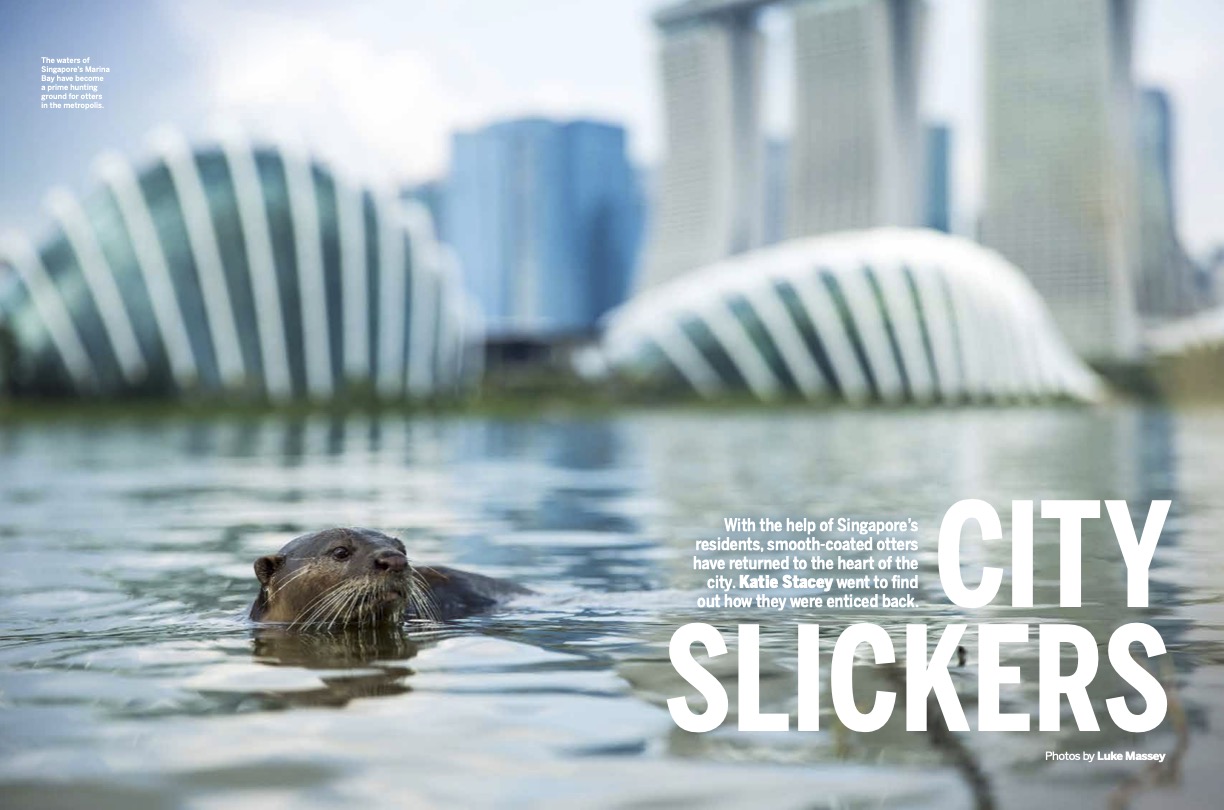
I've tracked Smooth-coated Otters through the streets of Singapore. Stood in the dark streets of Harar, Ethiopia, as Spotted Hyenas skulked past sleeping market traders. Explored the Chernobyl exclusion zone where wolves and elk now roam through abandoned towns.
From National Geographic, to BBC Science and BBC Wildlife, across every assignment, every species, every continent, one principle kept proving itself true:
You can't understand behaviour without understanding the conditions that created it.
Then I had children, and I realised I'd been training for this my entire career.
Because the same techniques I used to uncover stories as a wildlife writer I now use as a parent every day.
Here are the first four I think are most useful to my parenting life.
1. Learn to read the signs
When Luke and I landed in Singapore in monsoon season, soaked through and jet-lagged, we dumped our bags and went straight to the waterways to find the otters. We didn't find them that first afternoon, but we found something just as useful.
Scat on the bank, roll marks in the sand. The odd decapitated fish bobbing in the water.
The otters weren't there, but they had been, and the evidence of them was everywhere, showing us exactly where to look next.
Good wildlife storytellers don't wait for the behaviour to appear. They learn to read what comes before it.
With your kids: Every meltdown has a trail of signs that precede it. The slightly higher pitch, the shorter fuse, the withdrawal from play. Most parenting strategies start at the meltdown, by which point the nervous system is already overwhelmed and nothing lands. Start earlier. Learn your child's signals. That's where the real intervention happens, before anyone's dysregulated.
2. Use all your senses
We were sitting at the top of a vast valley in the south of Spain when the magpies began to alarm call. An Iberian lynx appeared at the base of the valley. It was clearly in hunting mode, whole body alert, moving with the focus of an animal that knows exactly where it's going. Luke watched for a moment and said: that lynx is hunting. It's heading straight up that hill and will cross the road. Let's go.
Nobody followed us. Nobody trusted that two English people knew something the crowds of regular watchers around us didn't. But Luke knew wildlife behaviour, and sure enough, the lynx continued its route a hundred metres upward and we were able to position ourselves within metres of it crossing. The bird alarm calls, the body language, Luke read that moment before it happened, and our reward was a once-in-a-lifetime encounter.
Wildlife storytelling teaches you to use your whole body as a sensing instrument. Not just your eyes, but your ears, the feeling in your gut, and the way the environment shifts before you can name what's changed.
With your kids: Your child's body communicates long before their words do. The tension in their shoulders. The energy of their silence, there's a calm silence and a loaded silence and they are completely different things. The way they're holding their jaw when they walk in from school. Start noticing with your whole body. You already know more than you think you do. Sometimes modern life gets in the way of you trusting it.
3. Look for the cause, not just the behaviour
When we went to Delhi to cover a story on the Black Kites, the city had an extraordinary problem. Thousands of injured birds were flooding into wildlife rescue centres every year. Wings torn, bodies lacerated, many not surviving.
Mohammed and Nadeem, the two brothers running Wildlife Rescue Delhi from their rooftop, treated them. Painstakingly, tirelessly, two thousand birds a year.
But they also asked the question most people weren't asking.
What is actually causing this?
The answer wasn't random bad luck. It was manjha, the glass and metal-coated string used in competitive kite-flying. One specific environmental cause producing a completely predictable outcome. Once you knew what you were looking for, you saw it everywhere. They set about campaigning to change the laws around kite-flying materials, treating the cause, not just the symptom.
With your kids: Most parenting advice acts on behaviour. But behaviour is always downstream of something else. The aggression after school, the dysregulation before bed, the defiance that seems to come from nowhere, these aren't random and they're not character flaws. They're signals pointing upstream to a condition that needs changing. Ask the journalist's question: what is the environment doing around this behaviour? Food, sleep, transitions, screen time, sensory input, your own stress level. Look upstream before you intervene downstream.
4. It's okay to ask for a guide
In the bitter Polish winter of early 2017, Luke and I flew to Białowieża, one of Europe's last primeval forests, to do a story on the European Bison. We landed at minus three degrees, were handed the keys to a car with snow tyres that looked entirely inadequate, and immediately got stuck in two separate snowdrifts.
We needed help, and we were lucky enough to find it. Rafal, a local scientist who knew every track, every feeding station, every place a bison was likely to appear at that time of year in those conditions. Without him we would have spent a week staring at empty forests and hoping for the best.
The best wildlife journalists I know aren't the ones who believe they know everything. They're the ones who know who to ask and who to listen to.
With your kids: For most of human history, parents didn't raise children alone. They raised them inside communities, with grandparents, aunts, neighbours, other parents who had already watched a thousand small humans navigate the exact moment you're currently stuck in. The isolation of modern parenting is recent and it's brutal. Asking for help isn't a failure. It's the oldest and most effective observational technique there is. Find the person who knows this terrain better than you do right now. A therapist, a mentor, another parent three years ahead of you, a community that understands what you're dealing with. It's something that has changed my own parenting more than almost anything else. You were never meant to do this alone.
If these first four techniques resonated with you, there's a practical place to start putting them into action.
The Three-Step Reset Guide walks you through a simple framework for observing your child the way a wildlife journalist would, so you can catch the signs earlier, read the signals better, and respond from a calmer place.
Download it free at thewildshift.com/three-step-reset