What Is Nature-Led Parenting?
What is Nature-Led Parenting?
It is not a set of rules. It is a way of understanding what shapes children's behaviour - and restoring the conditions that allow calmer, more connected family life to emerge naturally.
Definition
Nature-Led Parenting applies ecological principles to family life by restoring daily contact with the natural world to support children's behaviour, attention and emotional regulation. Rather than focusing on managing behaviour, it focuses on changing the conditions that shape it.
Where the idea began
For over a decade, I documented wildlife behaviour around the world as a journalist and filmmaker - peregrine falcons nesting on Chicago skyscrapers, deer moving through London streets, otters swimming in Singapore's city waterways, wildlife returning to the Chernobyl Exclusion Zone. Across all of it, one pattern kept appearing: change the environment, and behaviour changes with it.
In 2018, my husband Luke and I moved to northern Spain to restore a former dairy farm as a rewilding project, which we called Wild Finca. We had been inspired by places like the Knepp Estate, where a simple idea had produced extraordinary results: restore the right conditions, and life begins to return. We dug ponds, removed barbed wire, let hedgerows thicken, and planted native trees where they had been cleared. Slowly, the land changed. Birds nested in the scrub, amphibians found their way to the water and the sound of insects grew daily.
Then our children joined us and parenting made us look at everything through a new lens.
"We began to notice something striking: our children responded to the environment in much the same way as the land. When conditions shifted, so did they."
When they spent long periods indoors, at screens, overscheduled, told what to do, they became like coiled springs. Stress tolerance shortened, arguments escalated, disconnection became almost inevitable. But when they were outside, with space to move, natural sound and a slower pace, something else emerged. Curiosity replaced resistance, arguments dissolved more quickly, attention stretched naturally when it was given room.
Just as ecosystems respond to conditions, so do children. That observation became the foundation of Nature-Led Parenting.
Why modern childhood feels harder
Most parenting approaches focus on managing behaviour - through consequences, scripts, or emotional coaching. These tools can help, but behaviour is more often a response to environment than a problem to be corrected in isolation.
And the environment surrounding childhood has changed dramatically. For most of human history, children grew up largely outdoors - moving constantly, following their curiosity, in contact with soil, water, plants and animals. These were not incidental experiences, in fact they were the conditions in which children's nervous systems learned to regulate themselves.
Childhood evolved within
Natural light throughout the day
Constant, varied movement
Unstructured exploration
Contact with soil, water, plants, animals
Changing seasons and weather
Modern childhood often involves
Long periods indoors under artificial light
Limited physical movement
Structured, directed activities
Fast-paced digital stimulation
Constant background noise and media
When those environmental conditions change, behaviour often changes with them. Restlessness increases, attention fragments, transitions become harder and screens become the easiest available form of stimulation. Nature-Led Parenting begins from a simple reframe: behaviour is not the problem. The conditions around behaviour are.
The power of daily contact
One of the most common things I hear from parents is this: they know time in nature is good for their children, but they assume it needs to be a big adventure in a wild place to really count. When ordinary life doesn't allow for that, the idea gets shelved.
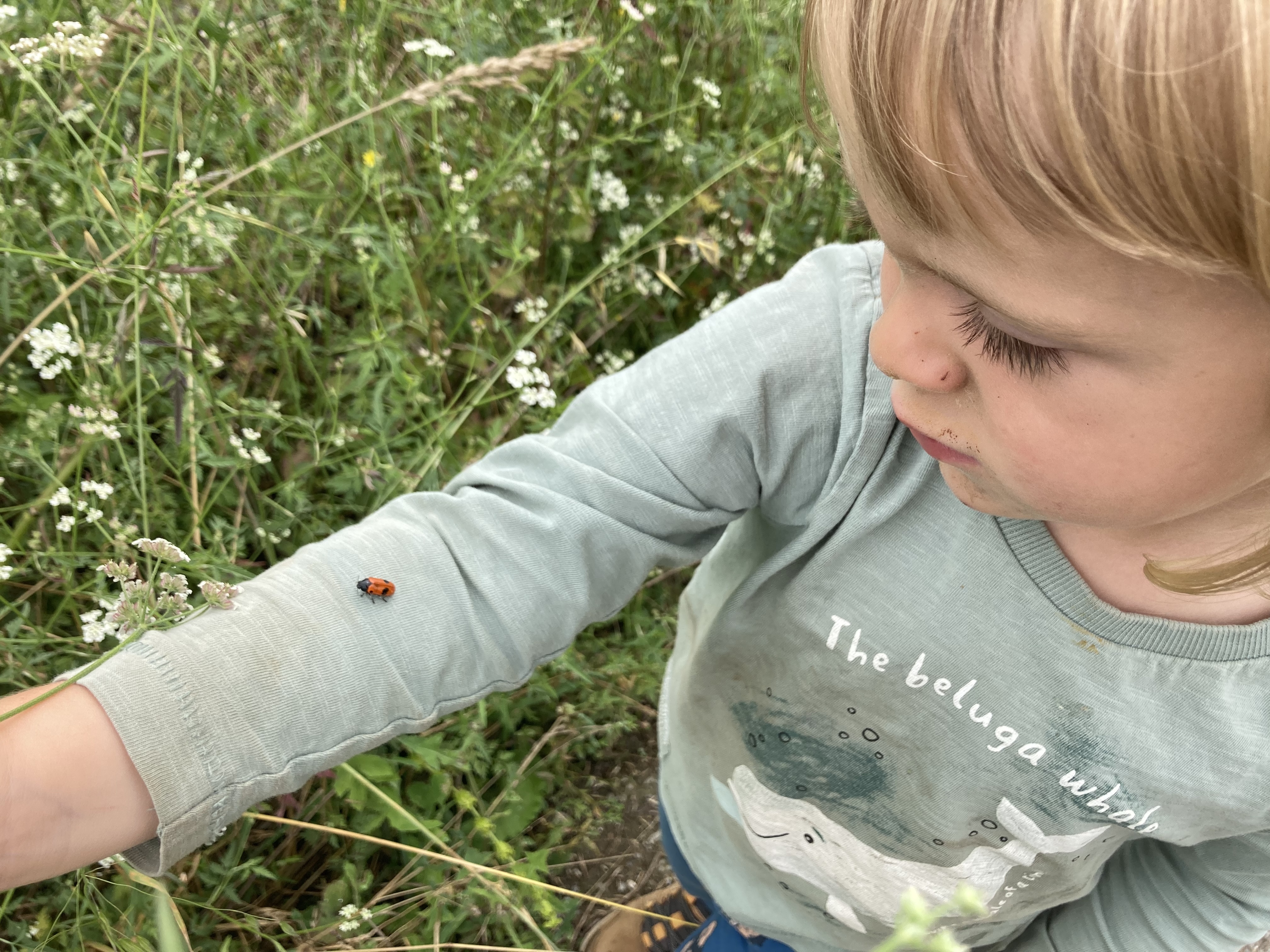
Here is what often surprises people: it is not the big adventures that have the greatest impact. It is the daily contact. Small, repeated moments of curiosity and awe, woven into the fabric of ordinary life, that compound over time.
The walk before school. Watching a snail cross the path. Digging in the garden for ten minutes. Pausing to listen to birdsong. These are not extras, they are the environmental inputs children's nervous systems were designed to receive - and they still respond to them, powerfully, even in small doses.
It is not about what you do outside. It is about making contact with the natural world a consistent, daily rhythm and allowing it to take root.
Where The Wild Shift™ comes in
Over time, the observations I had gathered from wildlife behaviour, ecological restoration and family life began to connect. They evolved into a practical framework: a way to use Nature-Led Parenting to gradually restore the environmental conditions children's nervous systems evolved within, not as a lifestyle overhaul, but as small, consistent shifts built into the rhythm of daily life.
That framework is The Wild Shift™. It begins with the parent, because children grow within the rhythm we model, and it works by restoring conditions rather than managing behaviour. When the environment shifts, the tone of the whole home begins to follow.
"As a mother of a highly sensitive toddler, this resonates so much... I wish I had had something like this earlier - especially for more sensitive children. Amazing what you're doing."
— Lyuba, on the free guide
A simple place to start
If you'd like to begin experimenting with these shifts in your own home, the free guide below introduces the environmental conditions that most reliably support calmer behaviour - and how to bring them into everyday family life.
Free guide - practical starting points for calmer, steadier days at home.
👉 Download the free guide: 3 Shifts That Change Your Child’s Behaviour