The Day We Found an Adder (and Why It Matters More Than You Think)
There is no doubt that it is handy having an in-house nature guide. Luke (my husband and teammate since 2014, when we first met in Zambia’s South Luangwa Park, where I was running a bush camp and he was the in-camp wildlife photographer) is an astonishing naturalist, an encyclopedia of nature knowledge. When the boys and I have a question, if Luke doesn’t know the answer, he knows who will.
He’s guided people around the world for both nature and wildlife photography - from Brazil to Estonia to Spain, and many more countries in between, as well as, of course, being our Wild Finca guide.
People sometimes say to me, “Well, it’s easy to be in tune with the natural world with him around.”
But there are two things I always come back to.
The first was reinforced the other day when I was having a cup of tea with my father-in-law, Luke’s dad (and I haven’t yet shared this with Luke, so here goes). He said to me,
“I am proud of him and his knowledge and his incredible connection with the natural world. His mum and I didn’t have that knowledge, so I don’t know where it came from.”
And while it’s true that Luke has an extraordinary depth of knowledge, it’s also true that he was given the exact environment to nurture it: space. Space to explore, to notice, to follow his curiosity.
His Dad does them a disservice, because while they may not know every bird or butterfly by name, they valued their garden, they spent time outside, and they encouraged Luke to do the same.
I was also given a good amount of freedom outdoors. And while I didn’t develop the same breadth of knowledge, I kept something just as important - a lasting connection.
Yes, there were years (especially through school and university) where I felt less connected. But it was always there. A constant. A place I knew I could return to for comfort, for curiosity, for perspective.
The second thing I share is this: while my boys are building an astonishing body of knowledge, the things that I see stick the fastest are the things we discover together.
And when I forget, for the umpteenth time, the name of a flower we’ve seen every year for the past four years, and they teach me… the joy they take in being my teacher is unparalleled.
And when they then pass that knowledge on to friends, it deepens even further.
I’ve started on a ramble but I feel the context matters.
Because what I’m really trying to say is this:
I believe that restoring daily contact with the natural world is vital for supporting children’s behaviour, attention, and emotional regulation in this modern environment.
Children (and really, all of us) are meant to experience the full spectrum of emotions. You can’t have the highs without the lows, just as nature has seasons, cycles, night and day.
The goal isn’t to eliminate discomfort. It’s to support the baseline, how easily we are triggered, how long we stay there, and how quickly we recover.
And I believe nature supports us all at every stage:
by helping to stabilise that baseline, by supporting us in the moment, and by aiding recovery afterwards.
Nature is one of the most powerful regulators of the nervous system we have access to.
And considering that screen time has become one of the biggest sources of dysregulation, I believe that regular, everyday time in nature acts as a powerful counterbalance.
While I started this blog series saying I didn’t feel the new UK guidelines offered a real alternative… I don’t actually think the answer is a direct swap.
It’s not “replace screens with nature.” Instead I believe it is a reassessment of the environment around screens - the pace of the day, the level of input your children have had, and the state they (and we as parents) are in.
When those are more balanced, the friction points begin to soften.
And all those small moments of nature connection? They compound. They create more space, more buffer, more curiosity, and more appetite for real-world engagement, self-directed play, and exploration. All of which naturally reduces the pull of screens.
We are currently in Wales for the school holidays, and I leaned on my parents this morning to look after the boys so I could get some work done. (A support network during the holidays is invaluable and a real privellege as in Spain, away from family it is something we are still trying to work out).
After that, we headed out for a walk to the beach. When we arrived, we set up a little base below the rocks and above us we immediately spotted a bird displaying. It was singing, rising, diving. We were all immediately drawn in. Then a second appeared. We discussed what was going on - and we deduced given the time of year and the behaviour that it was surely a male trying to impress a female.
Then another bird came whizzing through, breaking up the whole performance, before being chased away so the original could resume his woo-ing.
Curiosity is such a powerful state, and while moments like this can seem small, even trivial, they are anything but. They are shaping how our children think, learn, and relate to the world.
Here’s some of the science behind curiosity -
Curiosity Activates the Brain’s Reward System
What the research shows
Curiosity activates key brain regions linked to motivation and memory, including the midbrain and hippocampus.
How we know
A 2014 study by Matthias Gruber and colleagues found that when people were genuinely curious, they didn’t just remember the answers better, they also retained unrelated information encountered in that same moment.
In other words: curiosity doesn’t just help learning, it primes the brain to absorb more of everything.
Why it matters
Curiosity creates a deeper, more sustained form of engagement than passive consumption. It also strengthens learning, increases intrinsic motivation, and keeps children in that sweet spot of wanting to know more. This is the state where real learning sticks.
A note on dopamine
Dopamine isn’t just about “reward” - it drives the desire to seek, explore, and discover.
Fast, high-intensity stimulation (like many digital experiences) creates quick spikes that fade just as quickly.
Curiosity, on the other hand, creates a slower, more sustained release, one that’s tied to meaning, connection, and memory. It doesn’t just feel good in the moment, it builds something that lasts.
Takeaway:
Curiosity is more than a nice-to-have it’s a biological advantage. When a child is curious, their brain is more open, more engaged, and far more ready to learn.
And then, as we were leaving the beach, yomping up the sand dunes home we got chatting to some locals who we joked with about my two boys being the same as their dog Pepper - all three pinballing their way up the route.
One of them pointed out a rabbit hole and sent my son up to investigate. He ran off, then halfway up the incline turned and sprinted back shouting, “Viper! Viper! Viper!”
Well, I had to see it so I ran up to where he'd pivoted (normally he’d be quite calm about something like that, but I think he’d nearly stepped on it and given himself a fright).
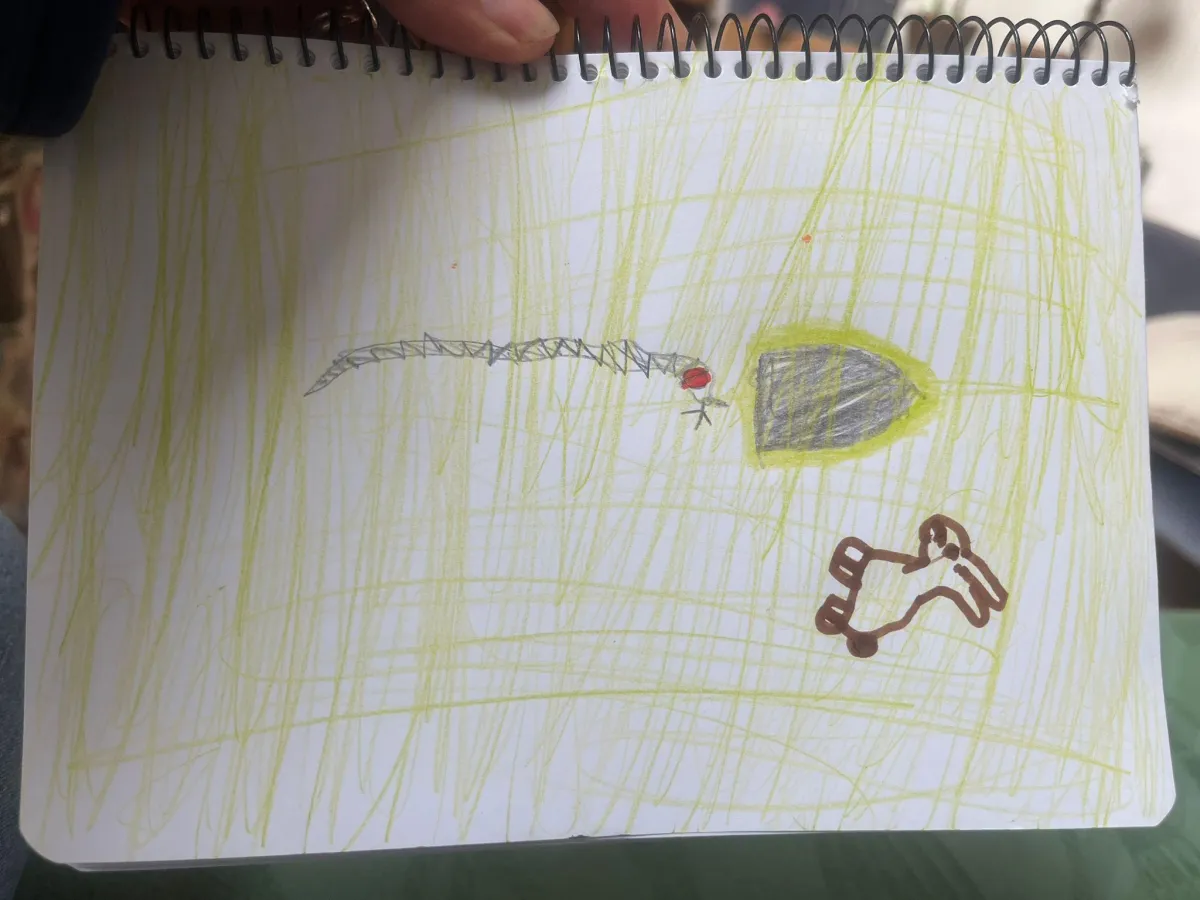
And he was right! It was a stunning Adder. We watched this huge black and white snake slither off into the undergrowth
We spent the afternoon listening to an audiobook, and drawing, Roan creating a beautiful rendition of that remarkable snake.
With all these wild creatures we spot, I can feel that thought creeping in—
Well of course they see these things… their father is a nature guide.
But that’s exactly the point, because this isn’t about expertise, it’s about attention.
It’s about getting your eye in, committing to small daily moments, and letting the magic and power of curiosity do what it does best.
Which is why I created the 14 Day Wild Shift.
If you want less friction, fewer screen battles, and more moments like the ones I am writing - this is where to begin.
It’s designed to fit into real life, in as little as five minutes a day,
so curiosity, calm, and connection become your baseline- not the exception.
And if it’s not working for you within a few days, I’ll refund you—no questions asked.
👉 Start The 14-Day Wild Shift here
"Me and my family loved taking part in the Wild Shift and would highly recommend it to other families. Rather than offering yet more strategies or filling you up with more things to remember it focuses on helping you to reconnect to the natural world which surrounds us all, with the gentle rhythm you can find there and reawaken within ourselves. It feels different to other programmes in it is not about trying to force individual behavioural change within your child, but helping you to provide the conditions in which gradual change can flourish- something the whole family can benefit from. The 14-Day structure makes it easy to actually put the ideas into practice, guiding you through what is made to feel simple steps which you can fit into busy family life and make a huge difference. Thank you so much Katie!"
Katy, Mum of two boys (6 & 3)
Read Owls, Awe And What Children Really Take With Them From Time in Nature (with Wildlife Kate)