Molehills, Catsharks, Shells & What Children Really Learn From Us
Being so close to the Castle means a morning walk as often as possible is a must. We check on the Jamón York in the back garden en route - the two pieces still remaining have little peck marks. Someone has had a go at them.
The castle is surrounded by a golf course and along the driveway there’re molehills everywhere. Albus, my four year old has a stick and is going through each one looking for bugs. It makes the going slow, and I have to remind myself that we are in no rush. We are in one of those rare pockets of time where we don’t have to be anywhere else. And this, right here, is what is giving him pleasure. So we stay with it.
So often these moments are hurried, in modern life it is the norm that we must be somewhere the very next minute and so often these moments of enjoying a moment are hurried and eventually we forget to indulge in them at all.
I believe these moments are vital. Not allowing ourselves to slip into that low-level (or sometimes high-level) urgency of needing to be somewhere. Because it’s not a good state for us to live in - and it’s not a good state for our children to learn from.
I think about this often. Children don’t really learn from what we say, certainly not in the way we hope they do. They learn from what they see.
From how we move through the world, how we respond to it, what we notice and what we miss.
There’s science behind this, something about mirror neurons, how a child’s brain quite literally fires in response to what we do, not just what they do themselves. And it makes sense when you see it play out.
If we rush, they rush. If we scroll, they reach for screens, and in the same way, if we pause… they begin to pause too.
I’ve read before about something called social learning theory, that children learn through observation, imitation, and emotional attunement.
But when you’re out here, watching it in real time, it feels obvious. Our presence becomes the pattern. The way we meet the world becomes the way they learn to meet it too, and I think that’s why these small moments matter more than we realise.
Pausing at a molehill, letting things take longer than they “should”. It’s not just about the moment itself, it’s what that moment is showing them.
And so we amble along, stopping for every mole hill, every friendly dog who wants a pat, every friendly local who wants a chat.
We get the traditional photos, absorb the landscape and begin the return to the cottage. This time a mining bee holds us up a moment. It looks a little worse for wear, covered in sand and struggling (or so it seems to us) to fly. Albus gently lets it crawl onto his hand and wonders off in search of a flower. Before said flower is located the mining bee regathers his strength (perhaps he had been fine all along) and flies off. But that moment of gentleness, of caring for another living creature, it’s something I try to encourage whenever I can.
From there we spend the rest of the morning at Mumbles peer, being proper tourists. A turn on the ferris wheel (which I had firmly said I had no interest in - and yet somehow found myself on). Albus turned out to be the bravest of us all, and I felt as nauseous as i'd anticipated!
Then to the upside down house which when I’d first entered had looked like an expensive five minutes. Until we watched another family over their shoulder filming a hilarious video of their kids, then flip the recorded video in the in phone edit, making it look like it was the kids walking on the roof. We spent a good half an hour after that taking endless videos and giggling ourselves silly at the result!
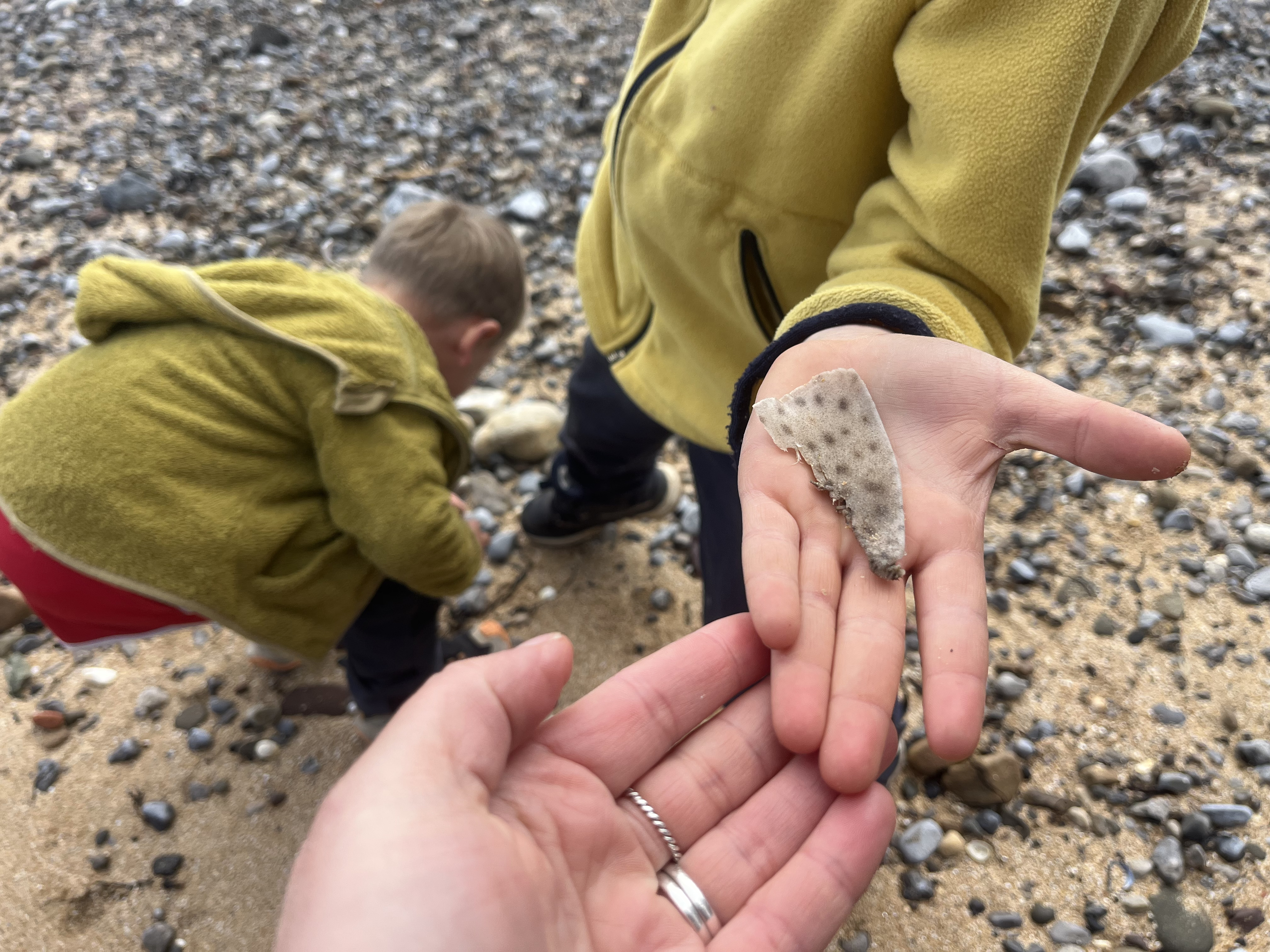
We wandered down to the beach in search of shells and found the small spotty fin of a suspected shark. As we left the beach after a good shelling we found the rest of the shark, which was in fact a Cat Shark (we think). A hot chocolate with all the trimmings and then we headed back to the cottage.
On the drive I asked the boys what had been their favourite activity that morning - the shark and the shells they both agreed. Not the ferris wheel or the upside down house but the small unexpected discoveries.
We’ve all caught some sort of cold this week, likely from the flight over. Albs went down first, Roan had a tough night last night, and today it seems to be my turn. As the pressure builds in my sinuses, I tap out for a nap. What a luxury to have the grandparents for this moment! Living in Spain away from family this is something we so rarely have, so I take full advantage of it!
I had suggested an audiobook and some down time but having missed out on the morning activities Grandpa ended up playing ball games with the boys for a full hour and twenty.
This could so easily have become a screen slot - and I wouldn’t have minded in this instance. But instead, over these days, I’ve watched something shift. Both boys have demanded these midday gaps be spent with tennis rallies and rugby kicks.
And as both boys hand/eye/foot coordination has improved over the days we have been here, they have become even more keen. It has been a joy to see them getting better each day. Day 1 tennis with Ro was somewhat exhausting with balls going in every direction, Day 3 and we’ve managed a rally of 4! And Albs is not far behind. With both their kicking has improved considerably since day 1…
I guess I share this as an example of what they’ve learnt and how they’ve grown in such a short space of time, being given the space to practice something instead of what could have easily defaulted into screen time.
By late afternoon, we head to Oxwich beach for more shells and crab hunting. There we meet a mum and her son - fellow enthusiasts. Roan begins a shell swap and it reminds me of the rhyme - she sells seashells on the seashore - except here, it’s more like she swaps seashells.
The other mum and I chat as the boys disappear into their own rhythm of turning rocks, crouching low, calling out when something exciting is found.
“I do it too,” she says. “I can spend hours walking up and down the beach.”
“It’s therapy,” I reply. And with my whole heart I believe it is.
Nature is the original nervous system regulator.
Children (and really, all of us) are meant to experience the full spectrum of emotions. You can’t have the highs without the lows, just as nature has seasons, cycles, night and day.
The goal isn’t to eliminate discomfort, it’s to support the baseline - how easily we are triggered, how long we stay in it, and how quickly we recover. And I believe nature can support us, and our children, at every stage:
By helping to maintain a steadier baseline, by supporting us in the moment, and by helping us recover afterwards.
Thats why I think that daily doses of it in some shape or form, however small, is critical to our wellbeing, our sense of joy in the world. Right now, we’re in a season of big doses - that’s what holidays allow. But I’m aware that real life resumes soon. And I think the real question is - what does this look like then? I’ll come back to that next week.
Despite all the fresh air, both boys tipped into that overtired, slightly wired place this evening, the kind that makes bedtime feel scrappy and strained. On these such evenings we lean on the Kids Meditation & Sleep Stories Podcast. It’s become a gentle landing for the day when their bodies are exhausted but their minds haven’t quite caught up yet.
A Simple Place to Start
If you’d like a practical starting point, I’ve created a short guide that introduces the environmental conditions that help restore calmer family rhythms.
👉 Download the free guide: 3 Shifts That Change Your Child’s Behaviour
I love this so much! So helpful — love the simple actions/reframes.
- Julie