The Boredom They're Not Getting
This week my biggest struggle after school has been getting the boys in for dinner.
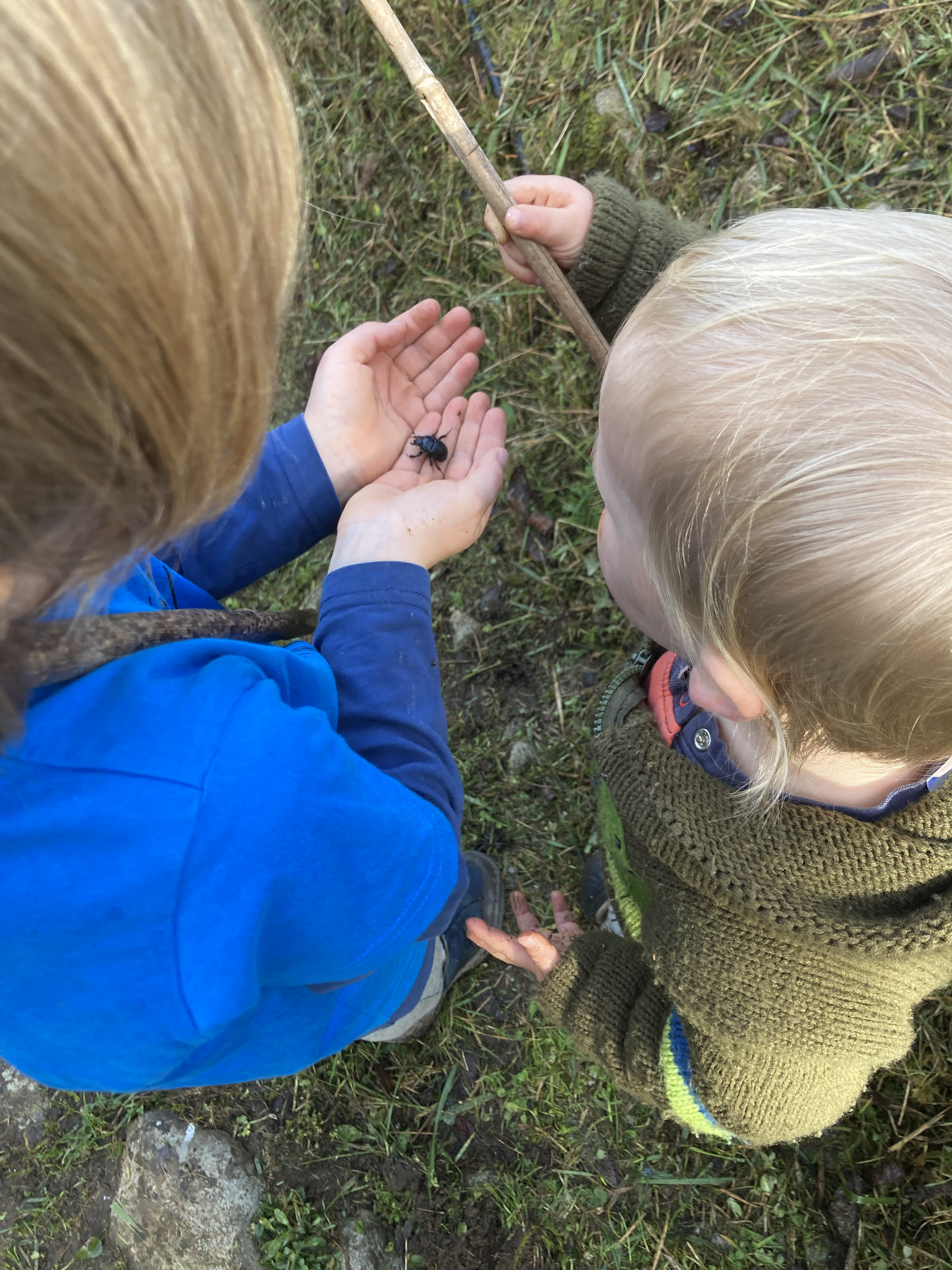
Roan has been building a home for birds - a proper one, with a water drinker and a bird feeder, designed and constructed entirely by a six-year-old with sticks, string and absolute conviction. Albus has been helping with the watering and then wandering off to do whatever Albus does, which changes every ten minutes and involves total absorption and zero explanation.
They are lost in their own worlds. And I have been standing at the back door, calling them in, feeling if I'm honest, something close to relief.
Because this is exactly what I've been hoping for. And it's also something I've been thinking about a lot lately.
We have become afraid of boredom.
Not just uncomfortable with it - genuinely afraid. We fill every gap, we schedule every hour and we hand over a screen the moment a child says I'm bored as if boredom itself is the problem to be solved.
But I think one of the greatest disservices we can do for our children is to not let them get bored.
That might sound counterintuitive. We're living in an age of enrichment - after-school clubs, educational apps, curated playlists, structured play. We want to give our children everything. And somehow, in doing so, we've accidentally taken something from them.
The space to find their own way in.
What Childhood Once Looked Like
For most of human history, children were not entertained. They were present - in the same spaces as adults, in the same landscapes, with the same materials available to everyone. Sticks. Soil. Water. Other children. Time.
Play wasn't scheduled, it emerged from boredom. A stick became a tool. A patch of earth became a building site. A fallen log became a balance beam or a boat or a dragon, depending on the day.
Adults were nearby but children were not constantly directed. The environment itself provided the stimulation - complex enough to be interesting, slow enough not to overwhelm.
And crucially, when nothing was immediately capturing a child's attention, they had to go looking. That search, that moment of what shall I do now, was not a problem, it was the beginning of imagination.
I think about this when I watch Roan at his bird house. Nobody told him to build it. Nobody suggested it, planned it, or provided a kit. He noticed the birds. He wanted to help them. And then he spent three afternoons figuring out how.
That's not just enrichment, that's something older and more important than enrichment. That's a child finding out what he cares about.
What Boredom Actually Does
There's a growing body of research on what happens in the brain during unstructured, unstimulated time and it's surprising.
When we're bored, the brain's default mode network activates. This is sometimes called the imagination network - it's involved in daydreaming, self-reflection, creative thinking and the ability to consider other people's perspectives. It's the part of the brain that makes us human in the most interesting ways.
Fast-paced screens suppress this network. There's no space for the mind to wander when the next stimulus is arriving every few seconds. But boredom - real boredom, the sitting-with-nothing kind - activates it.
In other words, boredom isn't a gap in learning. It's where some of the most important learning happens.
Studies have found that children who have regular unstructured time develop stronger creative thinking, greater persistence, and a better capacity for self-directed play. They become more comfortable in their own company. They get better at entertaining themselves, which sounds modest but is actually one of the most valuable skills a person can have.
And perhaps most importantly, they develop what psychologists call intrinsic motivation - the ability to be driven by genuine interest rather than external reward. Not doing something because someone told them to, or because there's a prize at the end, but because they actually want to.
Roan doesn't build bird houses because I asked him to. He builds them because he wants the birds to come.
The Rhythm That's Gone Missing
There's something else that unstructured outdoor time does that I think we've underestimated. It restores rhythm.
Natural environments move at a pace that developing nervous systems were designed for. Leaves move in the wind, birds sing, light shifts across the afternoon. These patterns are complex enough to hold attention but gentle enough not to overwhelm it. Psychologists call this soft fascination - the kind of gentle, effortless engagement that allows the brain to rest and restore itself at the same time.
Compare that to the pace of most digital media - rapid scene changes, bright colours, instant rewards, constant novelty. The brain is not resting during that. It's working hard to keep up. And when it stops, it often feels more depleted than before.
Modern childhood has, in many ways, lost the rhythm that once quietly regulated it. The movement between activity and rest. Between stimulation and stillness. Between doing and simply being.
When children don't have enough of the slower end of that rhythm - the wandering, the noticing, the building bird houses for no particular reason - everything else becomes harder. Attention is shorter, transitions are more difficult and the gap between stimulation and frustration gets smaller.
This is not a behaviour problem, in fact it's an environment problem.
What We Can Do
I want to be clear: I'm not suggesting we strip childhood back to something it can never be again. Screens aren't going away, schedules are real and modern life is genuinely busy.
But small changes in daily environments can restore some of what's been lost.
The most powerful thing I've found is also the simplest: protect the unstructured time. After school, before dinner, on weekend mornings and resist the urge to fill it. Don't suggest an activity, don't offer a screen. Let them be bored for long enough to find their own way through it.
It won't always look peaceful. The first few minutes often look like restlessness, complaint, mild chaos. I'm bored. There's nothing to do. Can I watch something?
Hold the line, gently, and then watch what happens next.
In my experience, it takes about ten minutes, sometimes less, and then something shifts - a child picks something up, starts something, follows a thread. And you lose them to their own imagination for the rest of the afternoon.
That's not nothing, that's the goal.
A Note on Being Nearby
One thing I've noticed is that unstructured time works better when an adult is present but not directing. Not hovering, not organising, not suggesting, just nearby.
This goes back to something I've been reading about lately in the behavioural science underpinning The Wild Shift. Children don't just copy our behaviour. They form their inner world by relating to ours. Which means when they see us slow down, notice things, follow our own curiosity, they absorb that as a template for how to be in the world.
So when I'm outside with the boys and I stop to watch a bird, or crouch down to look at something in the soil, or simply sit with my tea and do nothing, I'm not just resting, I'm showing them that stillness is allowed. That there doesn't always have to be a next thing.
If you'd like a practical starting point for restoring some of these rhythms in your own family, this is where most families begin:
👉 Download the free guide: 3 Shifts That Change Your Child's Behaviour