Go Touch Grass — But Here's What That Actually Means
I was on a podcast recently when the host said to me:
"We're constantly being told to go touch grass — but what does that even mean?"
I laughed, as a Brit I had never heard the term. I think my first guess was, is it something to do with cannabis? Which felt completely unrelated to what I was there to talk about! He explained it as American slang for 'go connect with nature, get out of your head' sort of thing - and I thought, well, that's basically my entire business in three words.
And then I started seeing it everywhere -
Just go touch grass.
Except it wasn't being said the way I had first been presented it. Somewhere along the way it had instead become the new calm down, Karen. A dismissal dressed up as advice. Someone recently explained it as: imagine someone getting worked up in a meeting and a colleague saying, "oh just go touch grass." That kind of thing.
And I get why that's happened. Advice without context is just noise. Get outside means nothing if nobody explains what you're supposed to do when you get there, or why it works, or why you can stomp around a park for forty minutes with your jaw still clenched and come home feeling exactly the same.
The phrase isn't wrong. The instruction is just incomplete.
"So… you just tell families to go outside more?"
I'm asked this often and I understand the scepticism completely.
Because many parents are already outdoors. They walk the dog, they run, they do the school run on foot. They clock steps. They move efficiently from A to B.
Someone said to me recently: "We're getting out for regular 8km walks, and we enjoy them, but it hasn't really changed things for us."
And I understand that too, because as good as that is, that isn't The Wild Shift.
The Coot's nest
Years ago, before we moved to Spain, Luke and I were working on a photography project supporting London becoming the world's first National Park City.
In the heart of the city, tucked behind a barge on a canal, we found a Coot's nest - built almost entirely from rubbish. Plastic. Twine. Scraps of city life, woven into something alive.
Luke lay flat on the pavement to photograph it.
People streamed past on their way to work - stepping around him, some nearly tripping over him, many visibly irritated at the disruption.
Out of roughly a hundred people who passed, maybe five stopped.
Five people noticed that a wild bird was raising its young right there, in the middle of London.
The rest weren't unkind. They were focused. Efficient. On their way somewhere else.
That moment has stayed with me because it showed me something I've seen again and again since - in cities, in families, in parenting:
Nature isn't missing. Attention is.
The Wild Shift isn't about where you go or how far. It's about how you're there.
Most of us have been trained to move through the world in a particular way. Eyes forward. Mind busy. Task-oriented. Getting through. Even outdoors, we're often still doing - tracking pace, distance, productivity.
But something different happens when attention softens. When we slow just enough to notice what's in between. The bird we weren't looking for, the sound we only hear when we stop, the beauty of the light as it fractures through clouds.
That's when something physical shifts.
Why it works: the science
There's a growing body of research on what nature actually does to the body and brain and it's more specific than most people realise.
Psychologists Stephen and Rachel Kaplan developed what they called Attention Restoration Theory - the idea that natural environments restore mental energy through what they describe as soft fascination. Unlike screens or busy environments, which demand active concentration, nature holds attention gently. Leaves moving in the wind, a bird calling from somewhere unseen, water bubbling in a stream.The brain engages without effort and in doing so, it rests.
But here's what's crucial. Soft fascination requires actual noticing. It doesn't happen automatically just because you're standing in a park. It happens when attention lands, even briefly, even lightly, on something real.
Separate research by Roger Ulrich and later by Park and colleagues found that even five minutes in a green space measurably lowers cortisol - the body's primary stress hormone. Lower cortisol means a steadier nervous system. A steadier nervous system means more capacity - for patience, for presence, for responding rather than reacting.
And the effect is contagious. Child development research on co-regulation shows that when your nervous system settles, your child's follows. Not because you've said the right thing or used the right script. Because their nervous system is in relationship with yours - reading it, mirroring it, taking its cues from it.
Your calm doesn't just feel better, it physically changes the conditions your child is living inside.
But none of this happens on autopilot, instead it happens when attention shifts.
What touching grass actually means
It doesn't mean a forest, it doesn't mean a mammoth hike. It doesn't mean knowing the name of that bird or plant.
It means this:
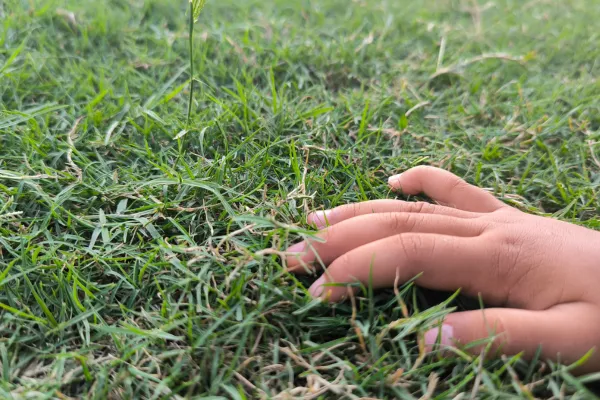
The next time you're outside - walking, running, heading somewhere - don't change your route, don't add another task, just let your eyes drift to the side and notice one small living thing you would normally walk straight past.
A weed pushing through a crack in the pavement. A spider's web catching the morning light. The sound of something moving in the hedge beside you. A cloud that looks like a dragon or a boat or a cat.
Stay with it for a few seconds longer than you normally would.
That's it. That moment of noticing - that tiny, deliberate pause - is the shift.
It sounds almost embarrassingly small but this is where the science and the lived experience converge: it doesn't take much. The nervous system is remarkably responsive to real-world input when we actually receive it rather than pass through it.
The Coot was always there. Luke saw it. A hundred people didn't.
Not because they couldn't. Because their attention was elsewhere, and they weren't tuned into it.
What this means for your family
Most of us already know that time in nature is good for us. We've heard it enough times. Get outside. Fresh air. Green space.
But here's what's rarely said: nobody tells us how to actually take the medicine. What dose. How often. What to do when you're tired and busy and the kids are resistant and the walk feels like just another thing to manage.
That gap is where most parents get stuck.
They go for walks, they let the kids run around, they do "outdoor time," and still not much changes.
Because it was never really about being in nature. It's about how you are when you are there.
When real life feels thin, rushed, or relentlessly overstimulating, children's behaviour reflects it. The defiance, the meltdowns, the constant friction - these aren't character flaws. They're a nervous system telling you the conditions aren't right. And you can't discipline a dysregulated nervous system into calm.
This is why The Wild Shift doesn't begin with behaviour, it begins upstream. With rhythm, with attention, with restoring moments where real life feels nourishing again - not bigger or busier, but richer.
At first it can feel deliberate. Almost ritual-like. Small doses, simple anchors, gentle repetition. But something interesting happens when those moments stack.
Your nervous system begins to settle more quickly. Your reactions soften. Your pace changes and slowly, something deeper shifts - you don't just do nature, you begin to move through the world differently.
And your family feels that.
I see it when I guide families at Wild Finca. They often arrive cautious. A little reserved, unsure how involved they want to be. And then, almost without noticing, something changes. Hands start lifting logs, questions begin. Children who "weren't interested" suddenly can't stop looking.
One family wrote afterwards: "It was like seeing nature as you remember it from childhood — an abundance of insects, birds, frogs, toads, butterflies and plants. Our children had the best time… an experience to remember and to inspire."
I once walked with a friend and her two-year-old daughter. The child crouched down, curious, gently poking her finger into a crack in the pavement.
My friend pulled her away sharply. "Don't touch that - it's dirty."
And in that small moment, a message was passed on. Not through explanation but through tone and tension.
We often wonder why children resist going outside. Why they won't get muddy, why they aren't curious about the living world around them.
The thing is they're usually just following our lead.
Children don't learn this through instruction, they learn it through modelling - through watching us feel these things, show these things, slow down for these things.
When parents slow, when attention softens, when curiosity is embodied rather than taught.
Children don't need convincing, they come with us.
That's the work, and it starts with you noticing the Coot.
If you'd like a practical starting point for bringing this into your family's daily rhythm, this is where most families begin:
👉Download the free guide: 3 Shifts That Change Your Child’s Behaviour