What Nobody Tells You About Strong-Willed Children
What Nobody Tells You About Strong-Willed Children
If you have a strong-willed child, you've probably been given a lot of advice.
Pick your battles, or stay consistent. Follow through every time, and don't let them win.
And underneath all of it, an implication that the goal is to soften them somehow. To sand down the edges. To make them easier to manage.
I want to offer you a completely different way of seeing your child.
Because the story you tell about who your child is shapes everything that happens between you.
And most parents of strong-willed children are telling themselves the wrong story.
What strong-willed actually means
Strong-willed children resist instruction. They push back on boundaries. They have enormous feelings and they're not quiet about them. They know what they want and they pursue it with a relentlessness that can leave the adults around them completely depleted.
They're also, almost always, the most curious children in the room. The most passionate. The most alive to injustice. The most likely to notice the thing everyone else walked past. The most willing to keep going long after other children have given up.
These aren't separate things.
The same wiring that makes your child so difficult to parent is the wiring that makes them capable of something extraordinary.
The question isn't how to change that wiring.
The question is what conditions allow it to flourish rather than combust.
The hunter-farmer hypothesis
There's an idea from anthropology that changed how I look at my two Teremoto's (what they call them here in Spain where we live - earthquakes, never a truer name given!)
For most of human history, children didn't sit at desks. They didn't follow timetables. They didn't transition between activities on a bell or manage their frustration quietly in a room with thirty other children.
They moved. They explored. They made quick decisions in response to a constantly changing environment. They questioned everything, because in a world where the wrong path led to real danger, questioning everything was a survival skill.
The traits we now struggle with in strong-willed children, the constant energy, the resistance to being told what to do, the relentless curiosity, the drive to move and explore and push against limits, weren't always seen as problems.
In a hunter-gatherer world, they were assets.
Anthropologists call this the hunter-farmer hypothesis. The idea that the traits we now associate with difficulty, with ADHD, with being too much, may have been precisely the traits that kept communities alive.
A 2020 study found that the genes associated with ADHD have been present in humans for tens of thousands of years. Long before classrooms existed. Long before we decided that sitting still and following instructions was the measure of a well-regulated child.
Same genes. Different environment. Completely different outcome.
*It is worth noting that this is ongoing research, but it resonates so much for me because I fell it in my bones that it makes sense. It feels logical. And so I don't share it definitively, I share it as another arguement to help you make sense of your family dynamic.
The environment problem
I think about this often with my own boys.
They have enormous energy. Relentless curiosity. A deep resistance to being told what to do without understanding why. If they had been born into a different environment, one more urban, more indoors, more rigid, they might easily have found themselves labelled. The characteristics are certainly there.
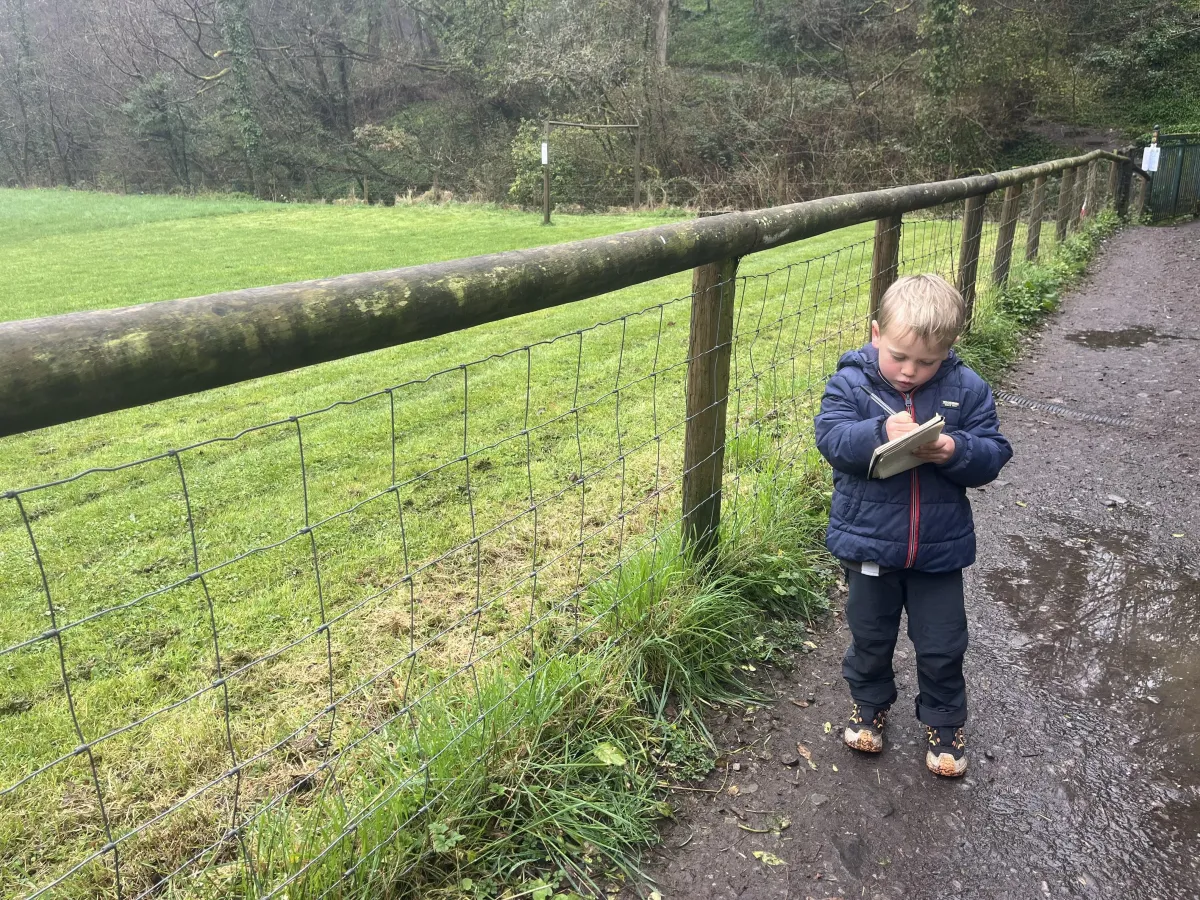
But in the environment we've built around them, those same characteristics look different. The energy goes into building cranes and exploring the finca and following a beetle across the path for twenty minutes to see where it goes, or like yesterday waiting by a small bath we use as a watering spot for the animals to wait for a grass snake to appear who had dashed below a rock in there at our approach.
The resistance to instruction becomes the ability to think independently. The relentlessness becomes persistence.
Nothing about them changed, it was the conditions around them that changed.
And this is the insight I want you to hold about your own child.
Every difficult trait is a superpower in the right conditions.
The child who won't back down becomes the adult who doesn't give up when everyone else has.
The child who feels everything so intensely becomes the adult who notices what other people miss.
The child who questions every instruction becomes the adult who doesn't follow a crowd off a cliff.
These aren't consolation prizes for a hard childhood. They're the real thing. The actual thing. The thing that will matter most when your child is grown.
Your job right now isn't to change who they are.
It's to understand what conditions allow who they are to become an asset rather than a liability.
Why the usual approaches don't work
Strong-willed children are particularly resistant to approaches built on control.
Consequences work on children who are motivated by avoiding consequences. Strong-willed children are often more motivated by autonomy than by avoiding discomfort. They'll accept the consequence rather than surrender the point.
Reward charts work on children who are motivated by external approval. Strong-willed children are often internally driven. They're not doing it for the sticker.
Scripts and gentle parenting language work on children who are in a regulated state and can receive them. Strong-willed children with dysregulated nervous systems often can't.
This isn't defiance for the sake of it.
It's a child whose nervous system is wired for independence, for self-direction, for high autonomy, being placed in conditions that don't account for any of that.
The mismatch produces the behaviour you're seeing.
Not the child.
What actually changes things
Strong-willed children need more autonomy, not less. More genuine choice, and more understanding of why, not just what.
They need to feel that their energy has somewhere to go. That their curiosity is welcome. That their intensity is held rather than managed.
And they need the same thing every child needs, a nervous system baseline that isn't already at capacity before the first demand of the day arrives.
Because here's the thing about strong-willed children specifically.
When they the conditions are created to allow for all of this, that same child has more resources available to manage the hard moments. The same traits that make them explosive when they're dysregulated make them genuinely capable when they're regulated.
Give them the opportunity to fulfill their needs. The cooperation, the connection, the capacity to hear no without detonating, these follow naturally when the conditions are right.
This is what I watch happen again and again, the child doesn't change. The conditions change. And the child who was exhausting and unreachable becomes the child the parent always knew was in there.
Curious. Funny. Passionate. Alive.
Just in the right conditions for all of that to come forward.
If you want to understand whether the conditions around your strong-willed child are part of what's driving the behaviour you're seeing, the Three-Step Reset Guide is the most practical place to start. Download it free at thewildshift.com/three-step-reset
And if you're ready to explore what changing those conditions looks like for your specific family, that's exactly what the conversation at The Wild Shift is for. You can find out more and book a call https://calendly.com/katie-stacey/discovery-call.
Because your child isn't too much.
They're existing in the wrong conditions.
And that is something that can change.