Part 2: What's Actually Happening When Your Child Finds a Beetle
Part 2: What's Actually Happening When Your Child Finds a Beetle
Your child crouches down to look at something, a snail, a worm after rain, a spider's web catching the light, and you're about to say "come on" or "don't touch that" or just keep walking.
But something is happening in their body in that moment. Something worth understanding.
Roger Ulrich studied surgery patients in identical conditions. Same hospital, same care, same recovery rooms, and the only difference was what they could see from their beds.
Brick wall or trees.
The patients who could see trees healed faster, needed less pain medication, and went home sooner. Same bodies, same care. Different view.
That's how strongly the nervous system responds to the natural world. Not in theory, but in measurable, physical ways.
Stephen and Rachel Kaplan spent years researching why this happens, and what they found is that the brain has two kinds of attention.
Directed attention is the hard kind. It's what your child uses all day to sit still, follow instructions, hold it together, move between tasks, and manage the noise and demands and expectations that fill a school day. It depletes, and it has a limit. And when it runs out, what you're looking at is the after-school meltdown, the dinnertime explosion, the bedtime battle that makes no sense.
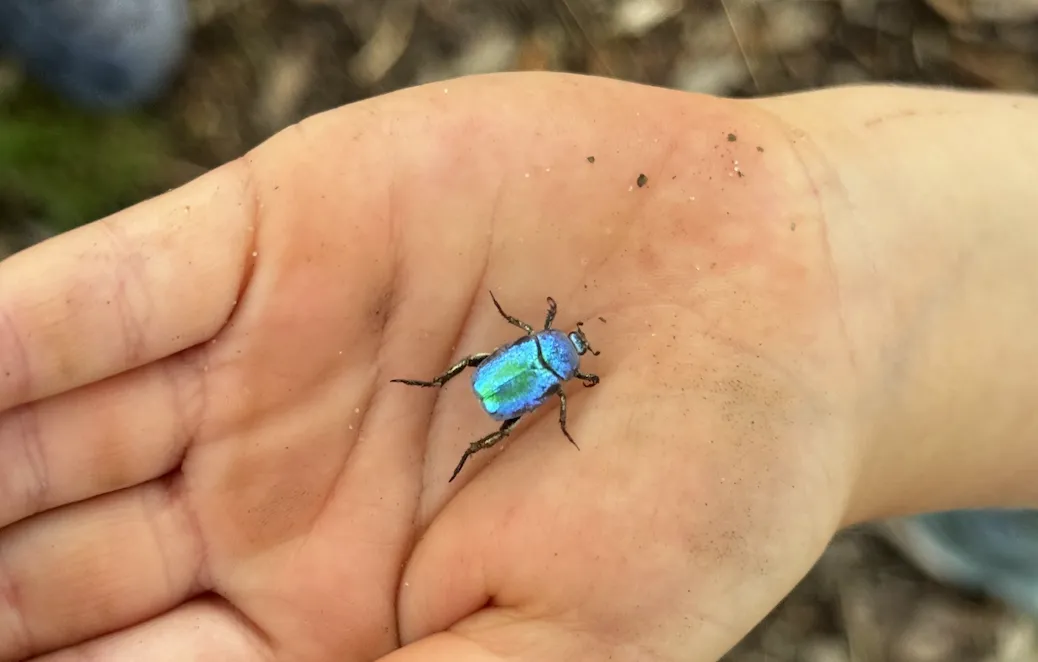
Then there's soft fascination. Watching water move, following a beetle through the grass, noticing the way light changes in the leaves. The brain is engaged but not working hard, and in that state the regulatory systems quietly recover.
This is why screens don't restore, even though they feel like rest. A child lying still watching a fast-moving show isn't in soft fascination. Their nervous system is still being driven, and the stimulation just looks passive from the outside.
Nature is different, and it was always different, because our nervous systems evolved surrounded by exactly these inputs. Natural light, birdsong, the movement of water, the rhythm of wind. These aren't nice additions to modern life. They're what the system was built for. When those inputs are present in the right way, they don't just improve mood. They shift the baseline. Your child's window of tolerance grows, the gap between trigger and explosion gets a little longer, and recovery gets faster.
But here's the part most people miss.
The effect deepens when attention actually lands, not just from being near nature, but from noticing something in it. Dr Dacher Keltner at UC Berkeley has shown that even small moments of awe, genuinely small ones, calm the nervous system, reduce stress, and help people feel more connected.
A spider's web. Light through leaves. The shells of blue beetles, collected one by one.
You don't need a forest and you don't need a full day outdoors. You need to know how to look and how to engage.
And you need to be looking too, because your child's nervous system doesn't just respond to nature. It responds to yours. They're reading your body before you've said a single word, and if you're half there, mentally scrolling through the day's list, they feel it.
But when you crouch down next to them and you're genuinely curious, something shifts. The moment becomes shared, and the regulation travels between you. That's co-regulation happening in a pine forest, in a back garden, on a pavement next to a crack in the wall where a beetle has just disappeared, or a flower is somehow, remarkably growing.
The setting isn't the point. How you are when you're there is everything.
In Part Three, I want to show you what this actually looks like to build into real life. Not a perfect day outside. Just the small, repeated things that actually change the baseline.
And if you'd like to talk about what this could look like for your family, you can book a call with me here: https://calendly.com/katie-stacey/nature-led-parenting-discovery-call