Part 1: Why Strong-Willed Child Behaviour Changes When You Stop for the Beetle
Stop for the Beetle
A Three-Part Series
Part 1: The Squirrel, the Beetle, and the Thing Nobody Tells You About Being Outside
We're on holiday in France, and this morning we cycled through pine forest to the village for coffee and croissants, and the morning already felt generous before we'd even started.
By the time we reached the village we'd already had Nightingales serenading us for a stretch of the route. Our first French Robin, which surprised us, because at home in Spain they're everywhere and we hadn't expected it to take so long. And many, many Hoopoes, which I am convinced are the ultimate punk rockers of the bird world. I'm trying to get my brother's girlfriend into birding, she's wonderfully glamorous and fashionable, and the Hoopoe is the bird I'm certain will be the one that hooks her. Sadly every one we've spotted so far has been moving too fast for her to get a proper look.
And then my eldest spots a Red Squirrel.
He almost falls off his bike with excitement. He races ahead shouting for my sister and dad to stop, to come and look, to come and see this glorious thing right there in the trees.
They don't stop.
A vague nod in the direction he was pointing, but they don't turn around for the squirrel. And he is a bit crushed, honestly.
Two days before, on the way in to meet the rest of the family, it had been just the four of us and we'd stopped at a nature reserve and spent two hours exploring barefoot.
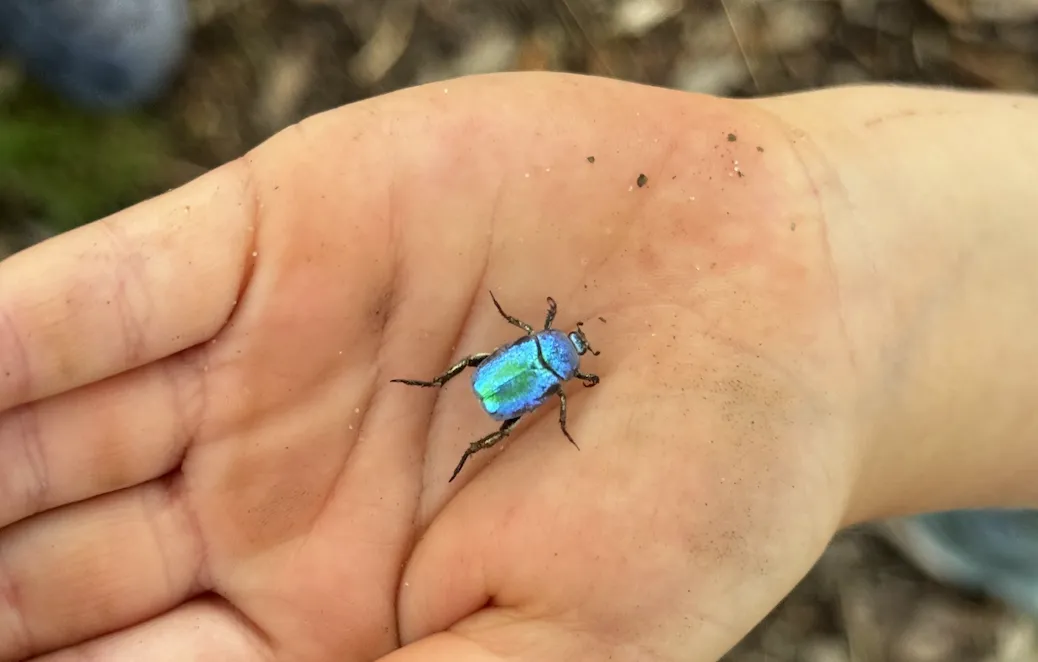
Albus found the beetle first, his discovery announced with the most electric squeal of delight. It was the most extraordinary blue any of us had ever seen on a living thing. An actual jewel, moving through the grass.
Then we couldn't stop finding the shells of them. Something had been feasting on the beetles and the boys collected every shell they could find, the most delight-filled treasure hunt you've ever seen.
When we arrived for lunch and the rest of the family was there, the boys had zero interest in hellos or food until they'd told the beetle story in full and shown every single shell.
That's the thing about real, engaged moments in nature. They don't need a worksheet or a goal or a screen to make them interesting. They land in a child's body and they stay there.
The squirrel mattered. The beetle mattered. The shells mattered.
And the adults who didn't stop missed something that could have shifted something for them too.
People say to me all the time: so you just tell people to go outside?
No, I don't. Because most families are already outside. They're walking the dog, running with headphones in, cycling to the village. They're out there, but doing it in the way we do most things in modern life, head down, otherwise occupied. Being outside and actually being there are two completely different things, with two completely different effects on the body.
That morning, we were all in the same pine forest with Nightingales singing and a Red Squirrel scampering through the canopy, but only some of the group truly experienced it. The rest moved through it without a second thought.
And I think this is one of the quieter losses of modern life. Somewhere along the way we were swept up into a pace that skips the small moments. But if you believe, as I do, that the journey is the living, then that idea has to apply to every step you take, not just the big ones. Every ordinary morning holds the chance to find something worth stopping for. Nature can offer you that, any time, in almost any place. But only if you know how to stop.
That's what The Wild Shift is actually about. Not telling people to get outside, but showing them how to actually be there when they are.
And the reason this matters so much for your child, and for the hard moments you're living in right now, is what I want to talk about in Part Two.
In Part Two, I want to show you what's actually happening in your child's body when they crouch down to look at something. And why your presence in that moment matters more than you might think.