Nature and Neurodivergence — What the Research Says (And What It Means For Your Family)
I want to start with something I say at the beginning of every conversation where this comes up.
I am not a clinician. I don't diagnose, I don't advise on autism, ADHD or learning differences, and I am not qualified to do so. If your child is on a waiting list for assessment, or if you are navigating a diagnosis, please make sure you have proper clinical support alongside anything else you are exploring.
Now here is what I also want you to know.
The question I ask myself about my own boys
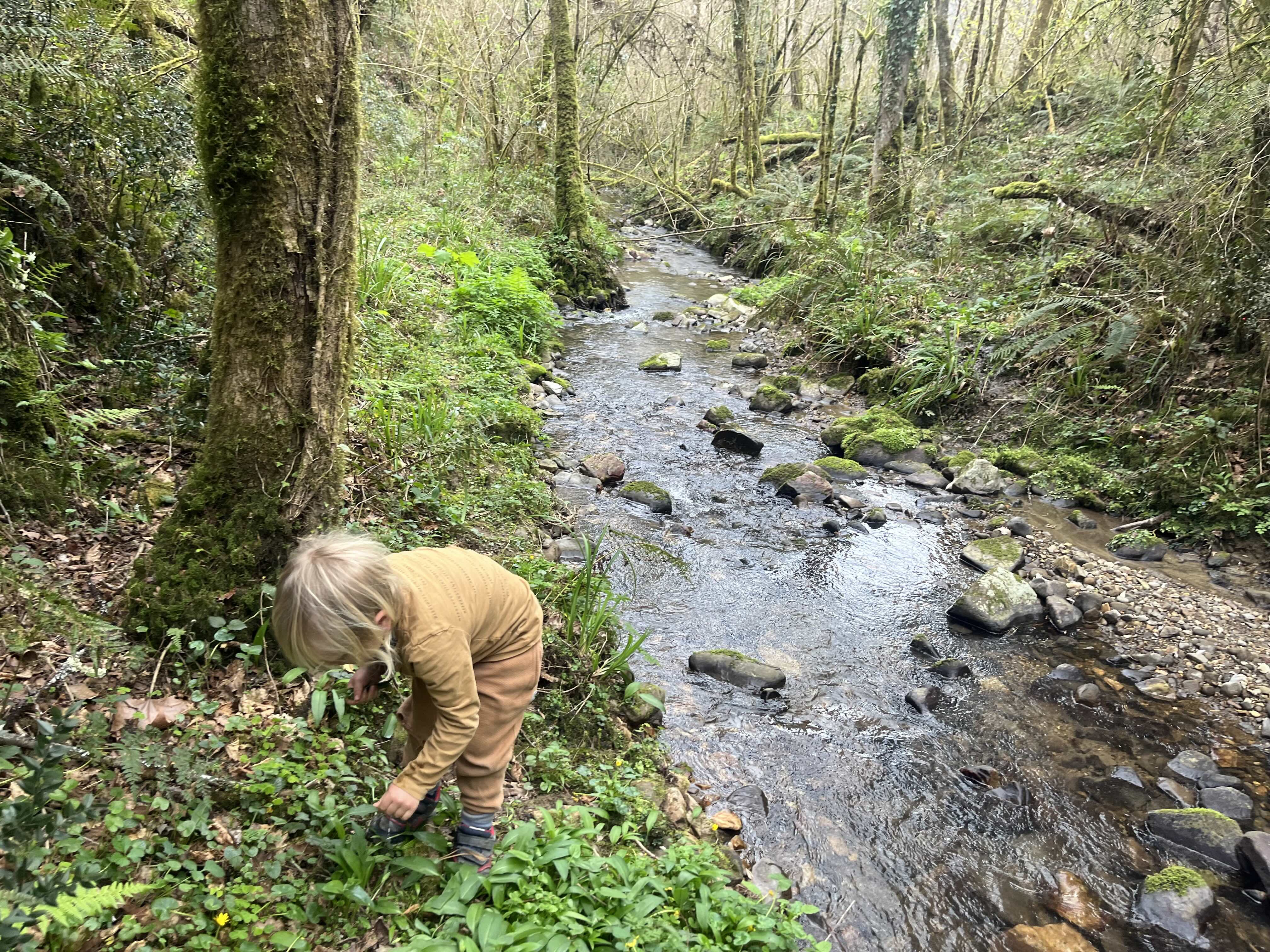
I have two sons. Roan is six. Albus is four. They are, by any reasonable measure, a lot.
Fast. Physical. Loud. Relentless in their curiosity and equally relentless in their resistance to anything that feels imposed or unfair. They feel things at full throttle. They move through the world like weather systems. Intense, unpredictable, impossible to ignore and, on the right day, which is more often than not these days, completely breathtaking.
I have thought many times, and I want to be honest about this, that if my boys had been born into a different environment, a more urban one, more indoors, more rigid, more structured around compliance and stillness, someone might have handed us a label early on.
I can recognise many of the characteristics that lead families to seek an assessment.
And it sent me down a rabbit hole that led me to some of the most fascinating research I have come across. Anthropologists have proposed what is often called the hunter versus farmer hypothesis. Many of the traits we now associate with ADHD, high energy, novelty-seeking, rapid responses, impulsivity and a drive to explore, have existed throughout human history. Some researchers have suggested that, in certain environments, aspects of these traits may have offered advantages, while creating significant challenges in others.
It's easy to imagine how, in some hunter-gatherer settings, a child who constantly explored, questioned and moved might sometimes have been an asset rather than a problem.
Interestingly, some genetic research has begun exploring these ideas, and I found the findings fascinating.
A 2020 genomic analysis spanning from Neanderthal samples to modern humans found that ADHD-associated alleles have deep evolutionary roots, present across tens of thousands of years of human history, and that their frequency began decreasing steadily with the onset of agriculture. A separate study of the Ariaal people of Kenya, one of the last remaining nomadic populations, found that men with ADHD-associated genetic variants had better nutrition and higher social standing in the nomadic group, while the same variants were associated with slightly worse outcomes in the settled group. Same genes. Different environment. Completely different result.
And a 2024 study published in the Proceedings of the Royal Society B found that people with ADHD traits were consistently better foragers than their neurotypical counterparts, moving on from depleted resources faster, finding more productive patches, gathering more overall.
There is a cave art site near where we live in Asturias, some of the finest examples of Palaeolithic rock art in the world, created on cave walls tens of thousands of years ago by the very hunter-gatherers whose genetic markers we now find in children being assessed for ADHD.
They painted wild horses and deer with extraordinary precision and beauty. Standing in those caves, I often find myself wondering what kinds of minds created them. Minds that observed the natural world with astonishing attention.
Human environments changed dramatically over thousands of years. Agriculture, permanent settlements, formal education and increasingly sedentary lives all placed new demands on attention, stillness and sustained focus. The same traits may be experienced very differently under those conditions.
Which raises an interesting possibility. That what we call ADHD may not simply represent disorder, but part of a much older pattern of human variation.
I am not saying that ADHD and autism aren't real. Nor am I suggesting that changing a child's environment removes their neurodivergence. It doesn't. What it can do is influence how those traits are experienced, supported and lived with, both by the child and by the people who love them.
I'm also not saying that assessment and diagnosis aren't valuable. They often are. They can unlock support, understanding and resources that change a family's life.
What I am saying is this:
Evolutionary research invites an interesting question: if these traits have persisted throughout human history, what might that tell us about the relationship between biology and environment?
Environment doesn't remove a child's traits. But it can radically change how often those traits are triggered, how intense they feel, and how hard they are to live with, for the child and for the family around them.
What the science says about nature and neurodivergence
There is a growing and genuinely compelling body of research on what natural environments do for children with ADHD and autism specifically. Not as a cure. Not as a replacement for clinical support. But as a layer of the conditions that matters, and matters more, not less, for children whose nervous systems often have to work harder to process the world around them.
On attention: Rachel and Stephen Kaplan developed Attention Restoration Theory, the finding that natural environments restore the brain's capacity for focus through what they called soft fascination. Gentle, effortless engagement with the living world that allows the brain to rest and recover. For children with ADHD, whose attention systems are already taxed, this kind of effortless engagement is particularly significant. A 2004 study by Kuo and Taylor found that children with ADHD who spent time in green outdoor settings showed significantly reduced symptoms compared to those who spent time indoors or in built environments. Not marginally. Significantly.
On stress and regulation: Roger Ulrich's research found that even brief exposure to natural environments measurably lowers cortisol, the body's primary stress hormone, within minutes. For children with autism or ADHD who often have elevated baseline stress responses, this is not a small thing. Lower cortisol means a steadier nervous system. A steadier nervous system means more capacity, for connection, for cooperation, for tolerating the things that are hard.
On sensory overwhelm: Modern childhood is relentlessly high-input. Fast-moving, always-on, artificially lit, acoustically busy. For neurotypical children, this is challenging. For children with sensory processing differences, it is often genuinely overwhelming. The natural world offers something different. Complex but not chaotic, stimulating but not assaulting. Research on sensory processing and natural environments consistently shows that outdoor, natural spaces reduce sensory stress in ways indoor environments simply don't.
On co-regulation: Your nervous system and your child's are not operating as two separate systems. A child's nervous system reads the physiological state of the parent in front of them, your breathing, your tension, your pace. For autistic children in particular, who are often acutely sensitive to the emotional and physiological states of caregivers, your regulation is their environment. When you are steadier, they feel it. When nature helps you get there, and the research is clear that it does, your child benefits before you have said or done anything.
On awe: Research by Dacher Keltner at Berkeley shows that moments of genuine awe, stopping in your tracks because something is extraordinary, reduce self-focused thinking, shift the nervous system out of threat mode and create a felt sense of being part of something larger than your own immediate experience. For a child whose world has contracted to the overwhelming, the anxiety-inducing, the too-much, awe is what makes the real world feel safe and expansive again. And you don't need a mountain. A spider's web catching morning light. A crow solving a problem. A worm emerging after rain. These moments are available every day.
What this actually looks like for families navigating assessment
The Wild Shift doesn't treat, diagnose or replace clinical support. I want to be completely clear about that.
What it does is work with the conditions surrounding your child, and yours. The rhythm of your days. The sensory environment of your home. The quality of your own nervous system when the hard moments hit. The nature contact woven into the ordinary fabric of family life.
These conditions matter for every child. But they matter especially for children whose nervous systems are already working harder, children who are more sensitive to overwhelm, more reactive to transition, more affected by the pace and input of modern life.
Whether you are in the waiting room, and in the UK and US right now, that waiting room can mean years not months, holding the uncertainty of not yet knowing, or you have the diagnosis in your hands and are working out what to do with it, the conditions your child is living inside matter right now.
Not after the assessment. Now.
If this resonates
If you are raising a child who is awaiting assessment, or who has a diagnosis, or who simply doesn't fit easily inside the standard expectations of modern childhood, you are welcome here.
The Wild Shift is not a clinical programme. But it is a real one, built on real science, lived in a real family with real children who are, by any measure, a lot.
You and your children, exactly as they are, are welcome here.
If you'd like to explore whether The Wild Shift might support your family alongside whatever else you are doing, I'd love to talk.
Because a diagnosis can explain your child's nervous system. It cannot replace the conditions that help it thrive.