How to Actually Be in Nature With Your Kids (Not Just Take Them There)
Restoring the Conditions
We're told that time in nature is good for kids. That it calms them down and helps them focus. That it makes up for too much screen time. And honestly? I think that's true. But what nobody ever told me was how to actually be in nature with them.
That's the part that surprised me, because I thought I already knew. I've spent years as a nature and conservation storyteller, watching wildlife, learning landscapes, paying close attention to the living world. But even with all of that, I fell into a trap that I think a lot of parents fall into.
I thought the big moments were the ones that mattered most. The long hikes. The wild places that took real planning to get to. I believed those were the experiences that would shape my kids. And when life got busy or I didn't have the energy to make it happen, I felt like I was letting them down.
Nature was supposed to be the answer to everything. But somewhere along the way, it had quietly become another thing I was trying to get right.
I was planning and packing and watching the clock. I was there in body, but my mind was still managing and worrying. I could feel it wasn't working. And then I started to notice something. The real shifts weren't happening on the big trips. They were happening close to home, in the small, ordinary moments.
It wasn't about doing more nature. It was about doing less, but more often.
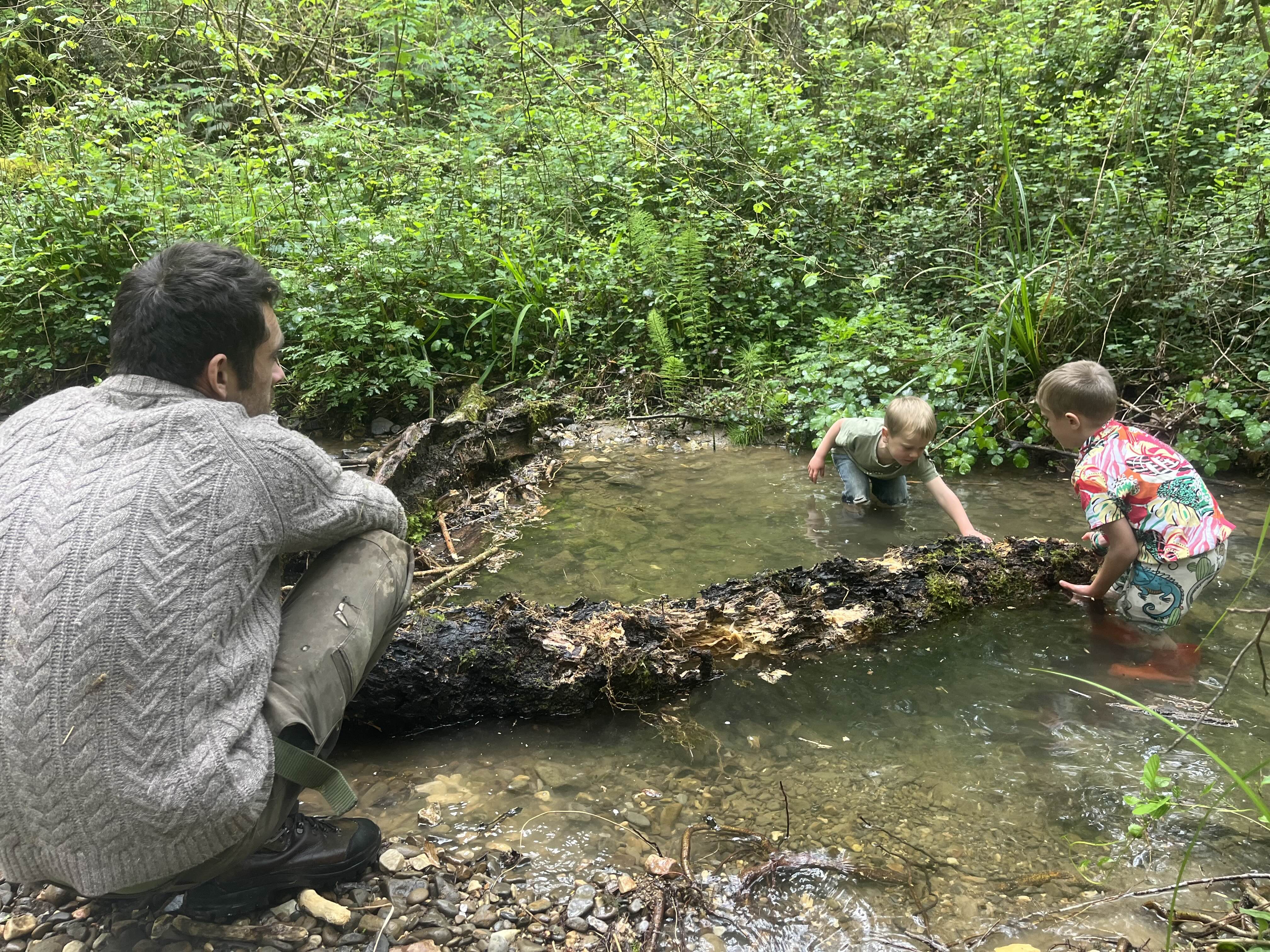
It was stopping at the fountain near our house to look for frogs. Five minutes watching clouds. Going back again and again to the same familiar spots. Pausing every time my boys spotted a bug or a moth on the road through town.
What changed wasn't my knowledge of nature. It was my relationship with time and attention when I was in it.
I started to see that my kids didn't need me to teach them or enrich them. They didn't need me turning every moment into a lesson. What they needed was company. A co-explorer. An adult who had slowed down enough to actually be there with them.
Long before children can calm themselves down, they do it with us. Our own state of being is one of the most powerful signals we can send them.
I couldn't explain my way into that. I had to practice it. Which means the way we show up in nature is the lesson itself.
Over time, this became the heart of what I now call Nature-led Parenting. I stopped thinking of nature as something I had to provide and started thinking of it as something we're already a part of, wherever we are. I learned to let the environment lead. To wait, to listen, to let things unfold without pressure.
As I softened, my kids followed. Transitions got easier. Arguments got shorter. Curiosity came back. They weren't "better behaved." They were more settled.
What I was learning was that nature doesn't just help children regulate their emotions. It helps relationships too. Long before anyone had words for nervous systems, nature was already doing that work, through rhythm, repetition, and the steady presence of the living world. Researchers call this attention restoration, the idea that certain environments gently refill our ability to focus, letting our brains rest and recover. In my own body, that restoration felt like a loosening. A settling. A return.
That lived understanding eventually led me to something I now call the ROOTS Framework. It's not a theory. It's language for something I was already living. It's less about what we do outside and more about how we are there. It starts with rhythm rather than rules, with attention rather than activities. And it asks parents to lead not by directing, but by modeling presence.
Over time, I started to see all of this less as a parenting strategy and more as a kind of rewilding, not of land, but of ourselves. When you rewild land, you don't force life to return. You restore the conditions and trust that what's already there will respond. Parenting started to feel the same way.
At its heart, it's an invitation to belong. To a place, to a moment, to each other.
In a world where screens feel both unavoidable and overwhelming, this is where my worry about them began to shift. Not because screens disappeared, but because I'd found another way to lead, rooted in calm, connection, and wonder. When I stopped trying to manage outcomes and started focusing on the conditions we were living within, something natural in my kids, and in me, began to come back. And as the feeling in our home changed, screens started to loosen their grip.
Here's what I believe: our children are born with a real connection to the natural world. We don't have to teach it to them. But the speed and pressure of modern life can pull them away from it, unless we stay rooted ourselves. And even if we've drifted, there's a way back.
Everything nature gives our children, regulation, attention, resilience, curiosity, it gives us too. And our kids need to see us receiving it. They absorb it by watching us live it.
For my boys, this has meant freedom to linger, to notice, to get completely lost in curiosity. For me, it's meant unlearning the belief that good parenting requires constant effort at scale.
Nature doesn't need to be explained to children. It needs to be inhabited by parents.
We're often told nature is essential, but rarely how to weave it into lives that are already stretched thin. What our children often need isn't bigger or wilder. It's slower, nearer, and shared.
When parents learn to arrive first, to settle, to notice, to move at the pace of the living world, nature stops being a solution and becomes a shared language.
I see it now in the smallest moments. My son stopping his swing to watch goldfinches feeding in the nearby trees. Both boys going quiet when the light changes suddenly and everything turns gold. A walk stretching longer because someone found a feather that needs careful inspection. The quiet seriousness with which a stone is handed over like a priceless treasure.
Joy lives where the ordinary becomes extraordinary.
These aren't grand transformations. They're daily ones.
And yet they're the moments that have reshaped our family life most deeply. They keep reminding me that another way exists, and that I can guide my children toward it simply by staying there myself.
I saw this clearly one afternoon when I wasn't feeling well and suggested a movie instead of going outside. My boys looked at me like I'd suggested skipping dinner.
Somewhere along the way, little scraps of time in nature had become as essential to them as eating or sleeping or breathing. And now they were the ones leading me back.
If you'd like to learn how The Wild Shift can bring connection and calm back to your home, I'd love to chat. Book a free call with me and let's explore what that could look like for your family: https://calendly.com/katie-stacey/nature-led-parenting-discovery-call